

Teddy Abdelmalek: The Resident-First Property Management Model That Protects NOI
When Teddy Abdelmalek told me his property management fee resets every single month based on whether he hits the NOI target, I stopped him mid-sentence. I’ve been buying, holding, and selling real estate since 1976, and I haven’t heard anyone structure a deal that way.
On a recent episode of The Whole Enchilada of Real Estate Investing, Teddy Abdelmalek laid out his property management playbook, and it starts with a fee structure I’ve never seen anyone else use.
Teddy brings 25 years of multifamily and student housing experience to the table. He recently joined HH Redstone, a vertically integrated ownership and management company based in Silver Spring, Maryland, to build out their third-party management vertical. The model he’s constructing is one I think every property owner needs to hear.
Some of the sharpest moments from this conversation stand on their own. Watch the highlights below.
Here’s a snippet of our conversation:
If you want the full conversation, the fee structure breakdown, the hospitality philosophy, and the preventative maintenance math that most managers ignore, the whole episode is below.
Operators like Teddy are exactly who we build episodes around on this show. Stay connected with his team through LinkedIn, Instagram, and Facebook.
Who Is Teddy Abdelmalek?
Teddy serves as Senior Vice President of Business Development at HH Redstone, where the company manages approximately 8,000 units (over 10,000 beds in student housing) across the country. The portfolio spans student housing, multifamily, affordable, mixed-use, and now senior housing.
Before joining HH Redstone in early 2025, Teddy spent decades in the student housing and multifamily space, building a reputation for operations that protect both the asset and the people living in it. What came through in our conversation was clarity: Teddy is building a management model where the company’s compensation depends on how well the asset actually performs, measured at the NOI line, not the gross revenue line.
The “Secret Sauce” of Property Management
I asked Teddy about his tools and tricks, and he went straight to what he calls the secret sauce. It had nothing to do with software or marketing funnels.
“The one single thing that you can do to really elevate your assets at the end of the day is really treating your residents as if they are the owners of the asset. And I mean, that kind of seems kind of weird, right? Like, why am I treating the resident as if they are the owner? Because really what happens is you get an ultimate benefit from them taking investment into your property and then treating your property as if it is their home, which you want it to be, right?”
“When you treat the residents as if they are the CEO, they are advocates at the end of the day. They’re advocates of your property. They’re advocates of your success. And more than anything, it is word of mouth and getting the word out about your specific investment.”
That resonated because we do something similar on the single-family side. We call our residents “homeowners in training” and “clients.” We run a program called the Path to Home Ownership, and it completely shifts the dynamic. People treat the property differently when they feel invested in it, and they stay longer because of it.
Why Impressing Owners Isn’t Enough
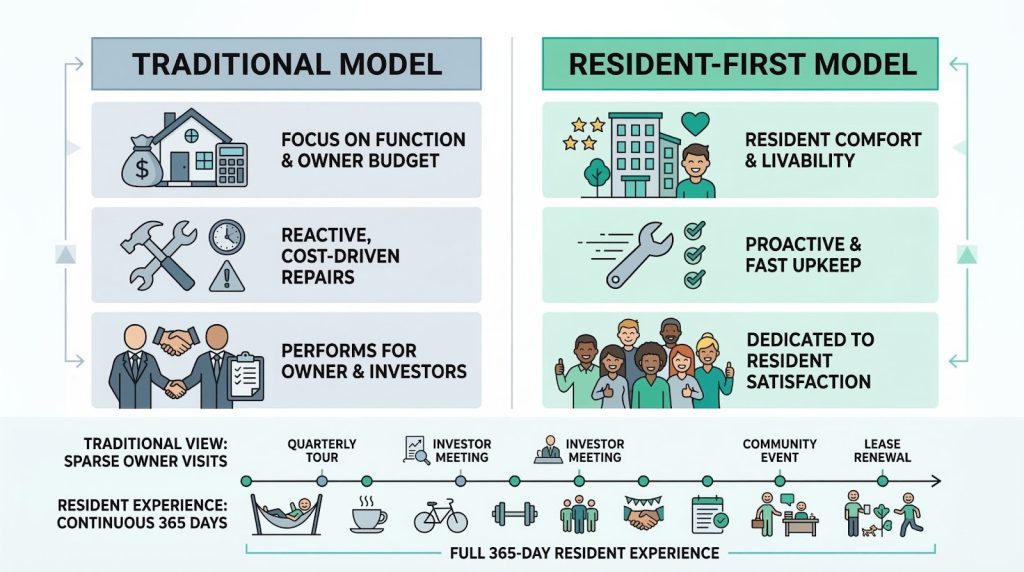
Teddy described a pattern that anyone who has owned rental property will recognize. The management team knows the owner is coming. Everything gets cleaned up, polished, looking perfect for that window. Then the owner leaves, and it all slides back.
“All too often our own people and third-party property management companies in general know that the ownership is coming. They know that someone from the executive team is going to be surveying the property and they clean up everything to make sure everything looks great… The minute the ownership leaves, the minute the executive leaves, everything goes back to normal. And it’s not those people that we should be trying to impress. We should be trying to impress the investors, the residents that are on our properties every single day, right?”
Residents live there 365 days a year. The owner shows up a handful of times. If your standard of care changes based on who’s watching, you’ve got a culture problem that’s bleeding money through turnover, reputation damage, and vacancy.
Hospitality-Driven Management Increases NOI
Teddy’s version of hospitality-driven property management draws a direct line between the hotel industry and apartment operations. With shelter costs accounting for a significant share of consumer price increases in recent years, residents are paying premium prices and expect the experience to match.
His approach includes practical, low-cost behavioral shifts:
- Professional dress standards for front-desk and leasing staff.
- Personalization: Using residents’ first names, and knowing their families’ and pets’ names.
- Consistency: Maintaining curb appeal every day, not just for scheduled inspections.
- Culture: Building community culture across every section of the property.
“Residents and customers today like hearing their own name. They like hearing their pets’ and their family’s names… Versus just asking, ‘Hey, when are you going to pay the rent? Why are you late on the rent?'”
These changes don’t require capital expenditure. They require intention, and they directly reduce turnover—one of the most expensive line items on any multifamily operating statement.
Preventative Vacancy & Preventative Maintenance
I introduced a concept I use in my business: preventative vacancy. Teddy grabbed onto it and connected it to preventative maintenance, the other half of expense control most managers ignore.
“If I’m not providing attention and focus, for example, to preventative maintenance, and I’m letting just even 10% to 15% of your toilets continually run, do you know what your water bill is going to be?… So, it’s a scale. Your revenue is up, but then you just lost all that revenue because you didn’t take care of something so simple like a running toilet.”
The real measure of management quality is what remains after expenses—the net operating income (NOI)—and that number demands attention on both sides of the ledger.
Performance Comparison
| Focus Area | Revenue-Only Approach | NOI-Focused Approach |
| Leasing | Fill units at any cost | Fill units while controlling concessions |
| Maintenance | Fix things when they break | Prevent breakdowns before they happen |
| Utilities | Not monitored closely | Audited monthly for waste |
| Staffing | Overstaffed to hit occupancy | Right-sized for efficiency |
| Retention | Not measured | Driven by hospitality and resident experience |
Ancillary Income Streams Beyond Rent
Teddy’s team is exploring ancillary income streams that add value for residents while generating additional property revenue:
- Financial Literacy and Co-Investment: Partnering with companies like Roots to offer resident rewards and co-investment opportunities.
- On-Site Health Services: Exploring partnerships with Pivotal Health to bring medical and urgent care services directly to residents.
- Reserved Parking: Tiered hospitality parking programs similar to major hotel chains.
On our end, we provide credit restoration, reduced-cost cell phone plans, and utility savings. Every service deepens the resident relationship and contributes income to the asset.
Disrupting Property Management Fees
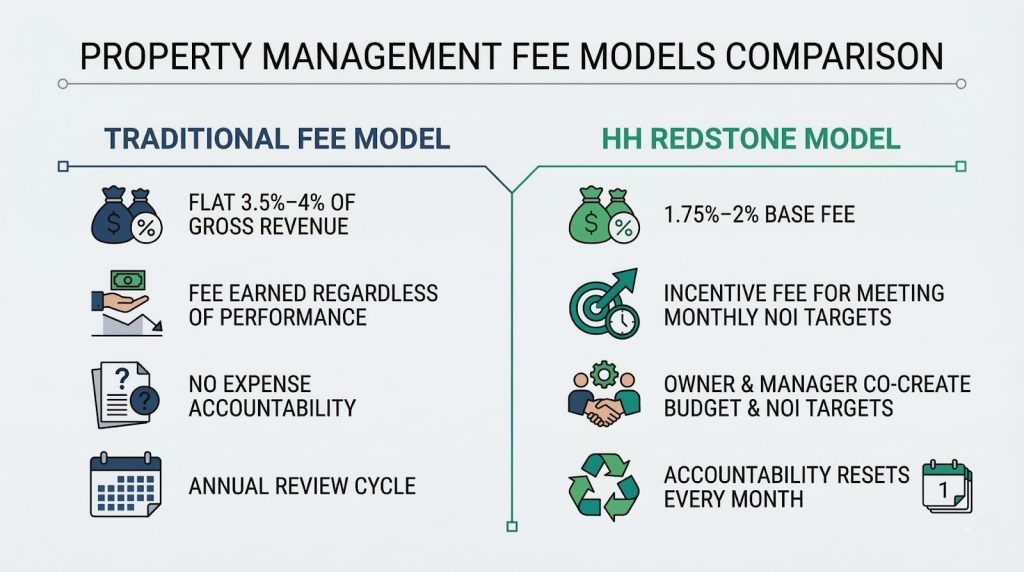
This was where the Teddy Abdelmalek property management philosophy got most concrete. The standard model charges 3.5% to 4% of gross revenue, regardless of bottom-line performance. HH Redstone uses a different incentive:
- Base Fee: Approximately 1.75% to 2% (well below industry average).
- Incentive: Kicks in only when the agreed-upon monthly NOI target is met or exceeded.
- Accountability: Resets every single month.
I told Teddy during the show that I don’t think anyone else is structuring deals this way. That alignment forces a management company to think like an owner, watching expenses with the same intensity they bring to leasing.
Treating Assets Like Equity Partners
Teddy frames his management philosophy as a virtual equity stake. His team doesn’t own a piece of the deal, but they operate as if their capital is on the line.
“We want our owners of real estate to feel like we have an equity stake in the deal, even though we don’t. I want them to feel like our money is on the line because really the sweat equity and the property management fee is on the line.”
Teddy’s approach positions HH Redstone as a legacy protector for owners building long-term portfolios, something I wrote about in Doing Good While Doing Well.
Advice for New Investors
I asked Teddy what he’d tell someone just entering the real estate space, and his answer bypassed deal analysis entirely.
“Definitely find a mentor… what you inherently have to have is the ability to be personable and kind and be just open and honest with yourself that this is something that you want to do and you want to take care of other people at the end of the day.”
Real estate is people first, operations second, revenue third.
Frequently Asked Questions
What is resident-first property management?
This approach treats residents as the primary stakeholders, using hospitality-level service to drive retention and reduce vacancy.
How does property management impact NOI?
Strong management increases revenue while controlling costs through maintenance, staffing efficiency, and waste reduction.
What is preventative vacancy?
Proactively retaining residents before turnover happens to avoid marketing, cleaning, and lease-up costs.
How do performance-based management fees work?
Fees are tied to actual NOI results, with incentive payments triggered only when monthly targets are met.
How do you reduce multifamily expenses?
Through preventative maintenance, right-sizing staff, monitoring utility waste, and auditing property tax assessments.
What are ancillary income streams in apartments?
Reserved parking, credit reporting, renters insurance, and innovative options like financial literacy programs.
How can hospitality improve apartment retention?
Personal recognition and professional presentation make residents feel valued, increasing renewal rates.
What percentage do property managers charge?
Traditional managers charge 3.5%–4% of gross revenue. NOI-tied models often use lower base fees (1.75%–2%) plus performance incentives.
How do you evaluate a property management company?
Look beyond occupancy; ask how they control expenses and if their compensation aligns with your NOI targets.
What is HH Redstone known for?
A vertically integrated firm overseeing ~8,000 units with a management model tied directly to NOI outcomes.
This podcast is produced by the Icons of Real Estate – #1 Real Estate Podcast Network
Apply to Be a Guest on the Podcast
The best operators in real estate are rethinking how management fees are structured, how residents are treated, and how NOI is protected from the inside out. If you’re building something that challenges the standard playbook, whether it’s a performance-based fee model, a hospitality-driven retention strategy, or an ancillary income approach that actually serves your residents, we want to hear your story.
Marigona Gllarevaa – Jan 01, 1970